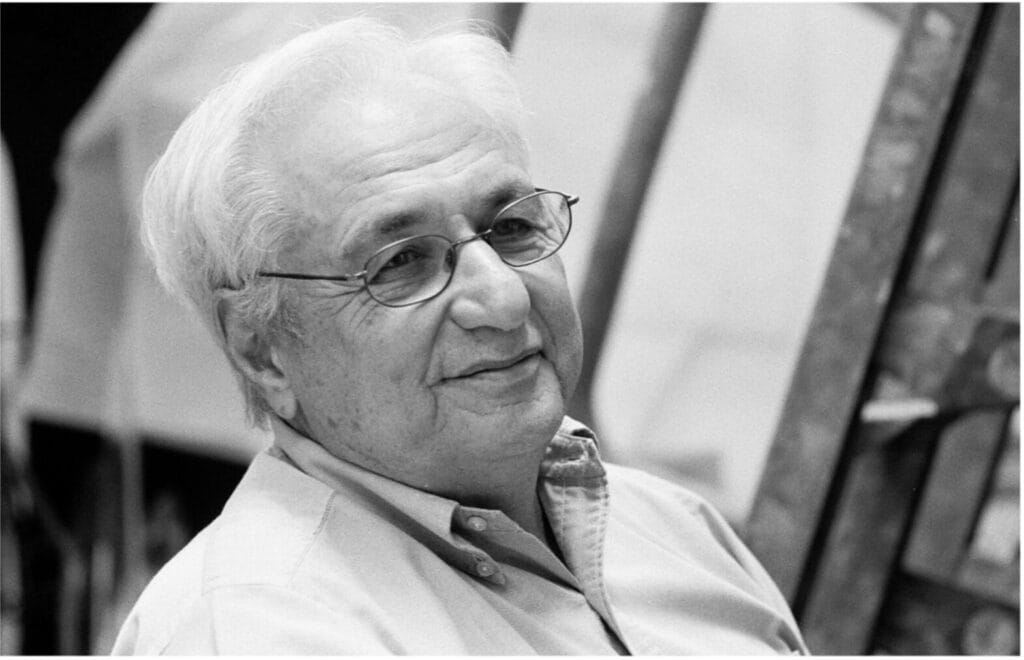
Gemini G.E.L., together with the Felsen and Grinstein families, join the many who are deeply saddened by the passing of Frank Gehry. For us, Frank was “family,” and our bond with him dates back decades. Beyond the visual impact Frank had on the city of Los Angeles, Frank had relationships deeply embedded within the Los Angeles art community, and he visited Gemini regularly, forming close friendships with many of the New York-based artists who were present collaborating in our workshops. In 1976, when Gemini decided to add a new building onto its property, Gehry was our first and only choice as the architect. Completed in 1979, it was one of Frank’s earliest commercial buildings in Los Angeles, with a gallery upstairs and printmaking studios on the ground floor. In fact, after graduating from architecture school, Gemini’s co- founder Elyse Grinstein worked for Frank and assisted in the design of our building. Frank’s buildings always seem to defy gravity, and, appropriately, during the early days of Covid, he added a wire “cloud” to span the space between our buildings, thereby creating an outdoor lunchtime dining area for our employees.

By 1999, Gemini invited Frank to do a project as an artist, and he created a large fiberglass sculpture which referenced a massive interior form within his DZ Bank building in Berlin. This was the first of several editions completed with Frank, which ranged from intimately-scaled lithographs, etchings and screenprints to a second sculptural edition referencing his telephone booth, designed in collaboration with the French artist Sophie Calle, sited upon a bridge spanning the Seine River in Paris.
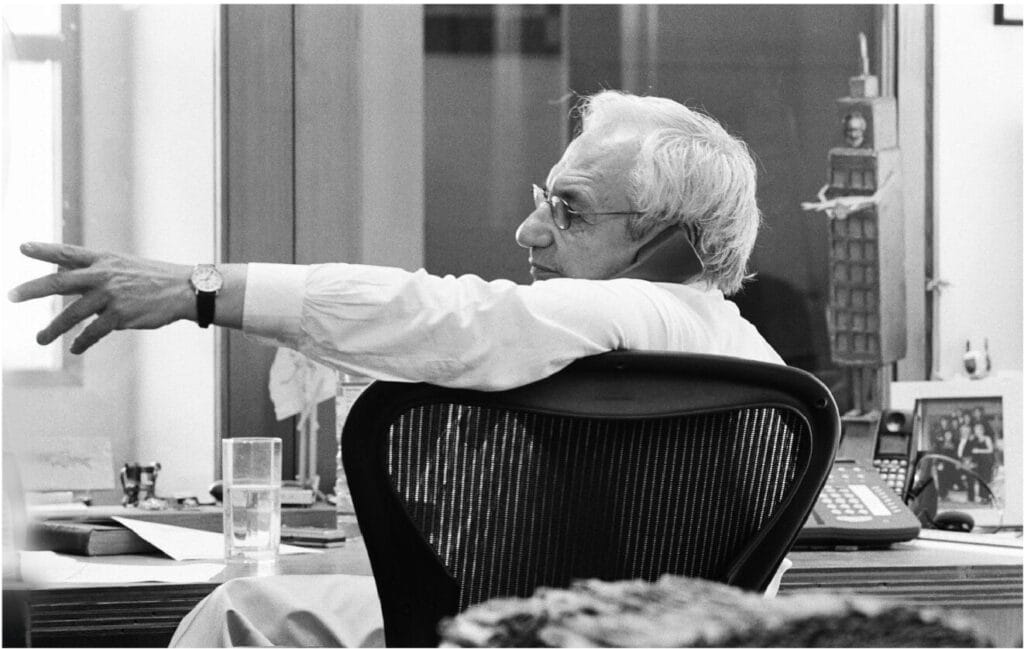
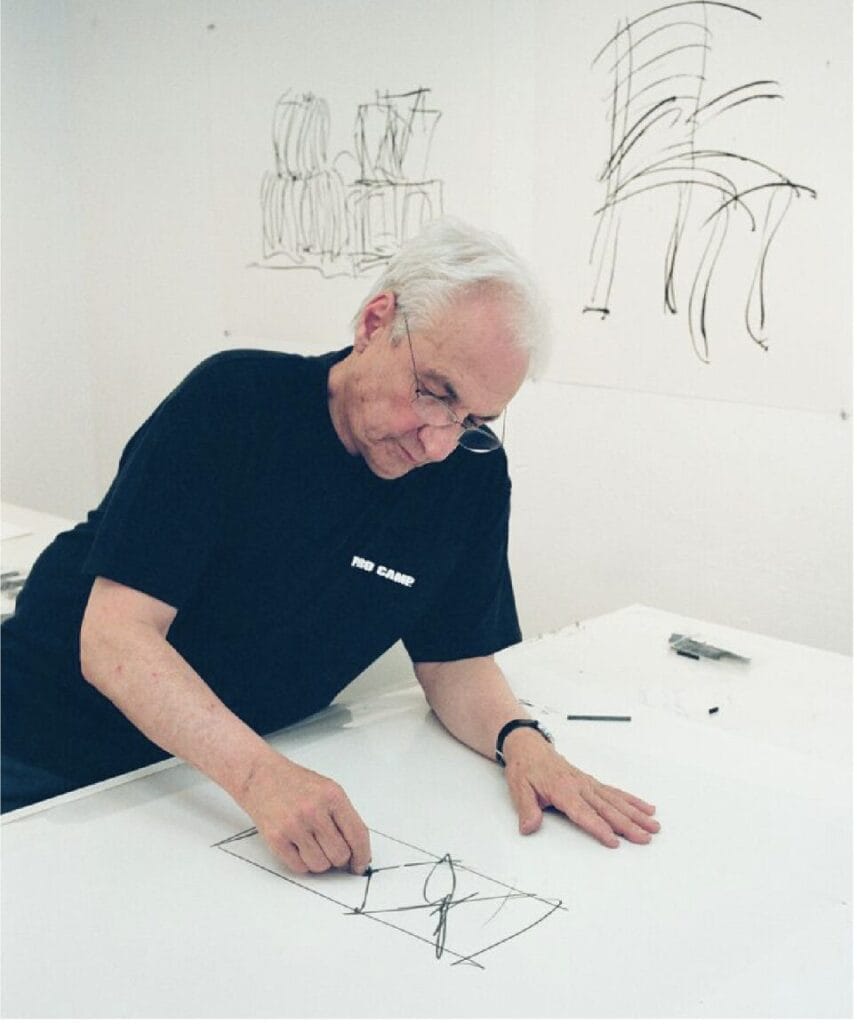
Among the most innovative architects in history, Frank’s designs have blurred the line between art and architecture, yet the aesthetic appeal of his sculpted creations never obscured the role of function. He always began each architectural project with a sketch, what he called the “tentativeness, the messiness.” From these drawings Frank refined his ideas until they finally were realized in tangible, three-dimensional form, and the dramatic nature of his buildings were a perfect inspiration for his elegant and gracefully energetic linear prints.
Frank’s prints often depicted various architectural projects— some recently completed as well as some unrealized — and while the prints were never actual preparatory sketches, they reflect the creative genius behind some of his most iconic buildings. Los Angeles was fortunate enough to have several, most famously the Walt Disney Concert Hall, which was especially meaningful given Frank’s engagement with music of all genres, from classical to jazz.
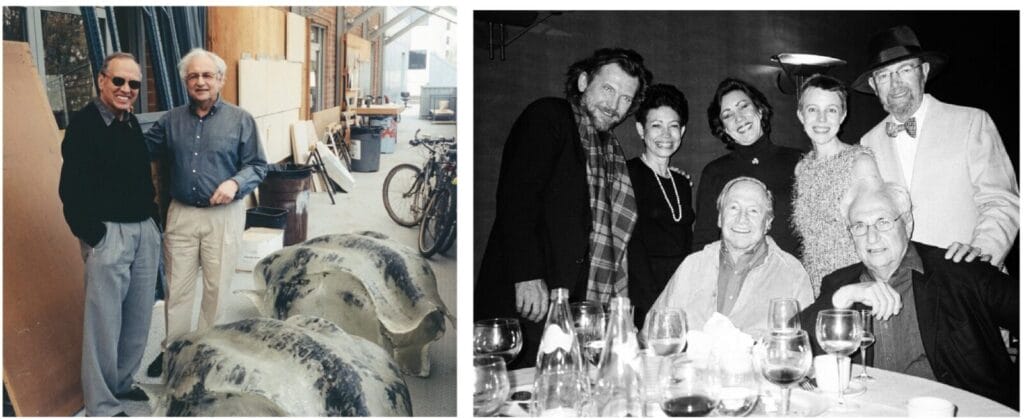
We were privileged to have had Frank in our lives for sixty years, and we extend our deepest sympathies to his wife Berta, to his personal family and as well as his professional family, those at Gehry Partners.
All photos © Sidney B. Felsen